San Jorge Lighthouse
IALA Heritage Lighthouse of the Year 2026 Nominee
Location: Argentine Republic, Province of Chubut, San Jorge Gulf, Landfall area for Comodoro Rivadavia Port
Lighthouse Operator: Servicio de Hidrografía Naval (SHN), Ministry of Defense of the Argentine Republic
Source: (photos from https://shn.gob.ar/faro-san-jorge as submitted by Servicio de Hidrografía Naval)
Lighthouse Description and History
San Jorge Lighthouse is a century-old aid to navigation that has been operational since 9 March 1925 and is located on Patagonian cliffs overlooking the gulf of the same name. Its prismatic tower rises 27 m, reaching a focal plane of 78 meters above sea level. It remains operational as an automatic aid to navigation, identified by National No. 1335 and International No. 1105, with a luminous characteristic of Fl (4) W and a period of 21.5 seconds, with a nominal range of 13.9 nautical miles from the sea.
Before the construction of San Jorge lighthouse over a hundred years ago, Comodoro Rivadavia lighthouse was located on the slopes of Chenque Hill. That lighthouse was threatened by continuous landslides, its range was insufficient, and it could be confused with the lights of the settlement and oil installations. Its location was also adversely affected by westerly winds, which stirred up clouds of dust and reduced the conspicuity of the signal.
The studies conducted by the Hydrographic Commission of the buoy tender Alférez Mackinlay revealed that a new lighthouse with a greater range would improve the landfall area and access to nearby anchorages. The construction of San Jorge Lighthouse met the need to improve the safety of navigation and access to Comodoro Rivadavia, whose port was the principal port in the Patagonia.
The process for the establishment of the new lighthouse formally began in 1923, when the studies commenced and the necessary projects, drawings and quotations were requested to the General Directorate of Supplies. On 7 January 1924, during the presidency of Marcelo Torcuato de Alvear, a decree of the Executive Power provided for the reservation of 10 hectares for public utility purposes near Cape San Jorge, which were intended for the installation of the lighthouse.
The event was recorded in Official Gazette No. 8979 and is associated with File No. 1-212/924-1-D.1167/924.
During 1924, the technical project, financing, and logistical organization of the work progressed simultaneously. The structure was designed by Engineer Jorge T. Tojo at the request of the Civil Engineering Division under the General Directorate of Supplies.
Finally, on 5 March 1924, the SHN received the complete project, together with its drawings, quotation, and hiring conditions. The Construction Commission was responsible for carrying out the work and was headed by Engineer Santiago Orengo, who reported the receipt of the construction supplies on 17 September of that year. Works began in November 1924.
The construction was made possible through cooperation between the SHN and state-run companies, namely, Yacimientos Petrolíferos Fiscales, Compañía Argentina de Petróleo ASTRA, Compañía Ferrocarrilera de Petróleo and Ferrocarriles del Estado. YPF, which was managed by colonel engineer Enrique Mosconi, spent 25,000 Argentine pesos on the construction. ASTRA promised 160,000 bricks and the lime required for the project and subsequently also contributed the acetylene cylinders intended for the lighting system.
Ferrocarriles del Estado was responsible for transporting supplies by railway, while the Compañía Ferrocarrilera de Petróleo provided the means of transport needed to complete their delivery to the construction site. For their part, the Hydrographic Service and the Ministry of the Navy took charge of the procurement and installation of the equipment for the marine aid to navigation.
Eng. Orengo informed the authorities by telegram that the construction was completed on 6 March 1925. The following day, the SHN ordered that San Jorge lighthouse be officially commissioned on 9 March 1925.
Reason For Nomination
Intrinsic Heritage Interest of the Lighthouse:
Its historic importance is directly related to the integration of navigation, oil production, and railway transportation that accompanied the growth of the Patagonia during the first decades of the 20th century.
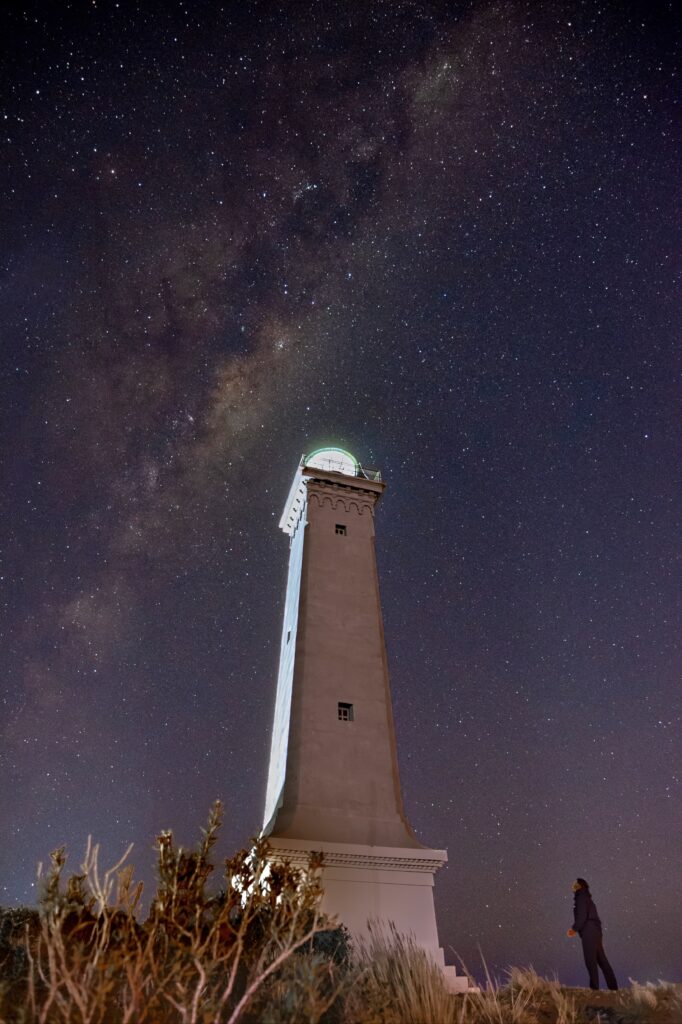
The most relevant architectural feature of San Jorge Lighthouse is its stepped prismatic tower with a square base, which is distinctive among Argentine lighthouses. Its shape differs from the cylindrical, truncated conical and open metal structures that predominate in the country, providing it with an instantly recognizable silhouette along the Patagonian coastline.
The base bears a compass rose, a feature that strengthens both its appearance and its symbolic link to navigation, the land and interpretation of the marine horizon. Its design reflects the industrial and functional architecture of the beginning of the 20th century, in which monumentality and building details were directly associated with its purpose as an aid to navigation.
San Jorge Lighthouse still retains many original elements dating from its commissioning more than a century ago. The lantern room retains its cast-iron walls, copper roof, concave glass panes and metal door, whilst the tower still features the staircases, handrail and other historic components. The original 800-millimetre lens, the flashing mechanism and the acetylene power supply system were replaced and modernized to ensure the signal’s continued operation, whilst preserving its historic architectural configuration.
The environmental conditions in Patagonia posed a major challenge to its construction, as strong winds hampered the original building work and even forced the suspension of work at height due to the risk to workers.
More than a century later, the winds, sand, humidity, and coastal exposure continue to pose particular challenges for maintenance work.
The municipal procedure for San Jorge lighthouse began on 6 November 1989 with Decision No.11 issued by the Assessment Commission on Cultural and Natural Heritage matters. In 1999, Decision No. 6629-1/99 created the Permanent Registry of Buildings, Sites and Objects from the Historic, Cultural and Natural Heritage of Comodoro Rivadavia. The lighthouse was formally recognized on 21 July 2005 through Decision No. 8429/05, which declared it a heritage of the city and ordered its inclusion in the municipal heritage register and established its marking as a protected asset. This situation was ratified in 2023 through Municipal Order No. 6629/23, enacted by Decision No. 2844/23.
In a nation-wide level, National Law No. 26650 enacted on 20 October 2010 and promulgated on 15 November of the same year created a System of Centennial Lighthouses and established the assessment of lighthouses when reaching their 100th anniversary to determine their classification and inclusion within the system. After reaching the 100th Anniversary of its commissioning on 9 March 1925, San Jorge lighthouse is undergoing an assessment procedure carried out by the National Monument, Site and Historic Asset Commission for its classification and formal inclusion.
In light of the foregoing, it is possible to affirm the existence of a particular architectural setting in Argentina, a high level of material authenticity, a history which is closely related to the maritime, oil, and railway development of the Patagonia, the continuity of its navigational function and its active cultural link with the community, all of which turn San Jorge Lighthouse into a living legacy.
Conservation:
The lighthouse is in generally good overall condition. Its maintenance combines the systematic inspection of its structure and equipment, preventive maintenance, the recovery of its architectural components and the updating of the necessary systems to ensure the signals’ reliability. Its maintenance does not constitute a recent action exclusively associated with its heritage recognition, but an institutional responsibility which can be evidenced by documents from the first decades of its commissioning.
During its first years of operation, inspections and conservation tasks required the participation of Navy units that went to the area to support the operation of the signal, a task which was assumed by the buoy tender Alferez Mackinlay and the Oceanographic Vessel Comodoro Rivadavia between 1930 and 1940.
The work carried out during that period was not limited to general inspections; in 1940, work was carried out on the selector box and the system’s 32 accumulators were replaced, as were the window panes. In 1968, the interior dome, staircases, supports, doors and windows were repainted, and the tiled floor was replaced with a concrete one.
Cooperation with the Municipality of Comodoro Rivadavia began to be formalized in the late 1990s, when the Municipality and the Assessment Commission on Cultural and Natural Heritage matters fostered an agreement with the SHN to protect and enhance the lighthouse. Between 2004 and 2005, an overall recovery intervention was carried out with municipal participation, which included work inside and outside the building, the repair of plaster and cracks, floors and pavements; restoration of ornamental and metal features; painting; restoration of handrails and staircases; protection of windows; improvements to lighting and signaling; and measures designed to minimize the effects of vandalism. The project provided for an extensive restoration of the building and established a model of shared conservation between the maritime authority and the local government.
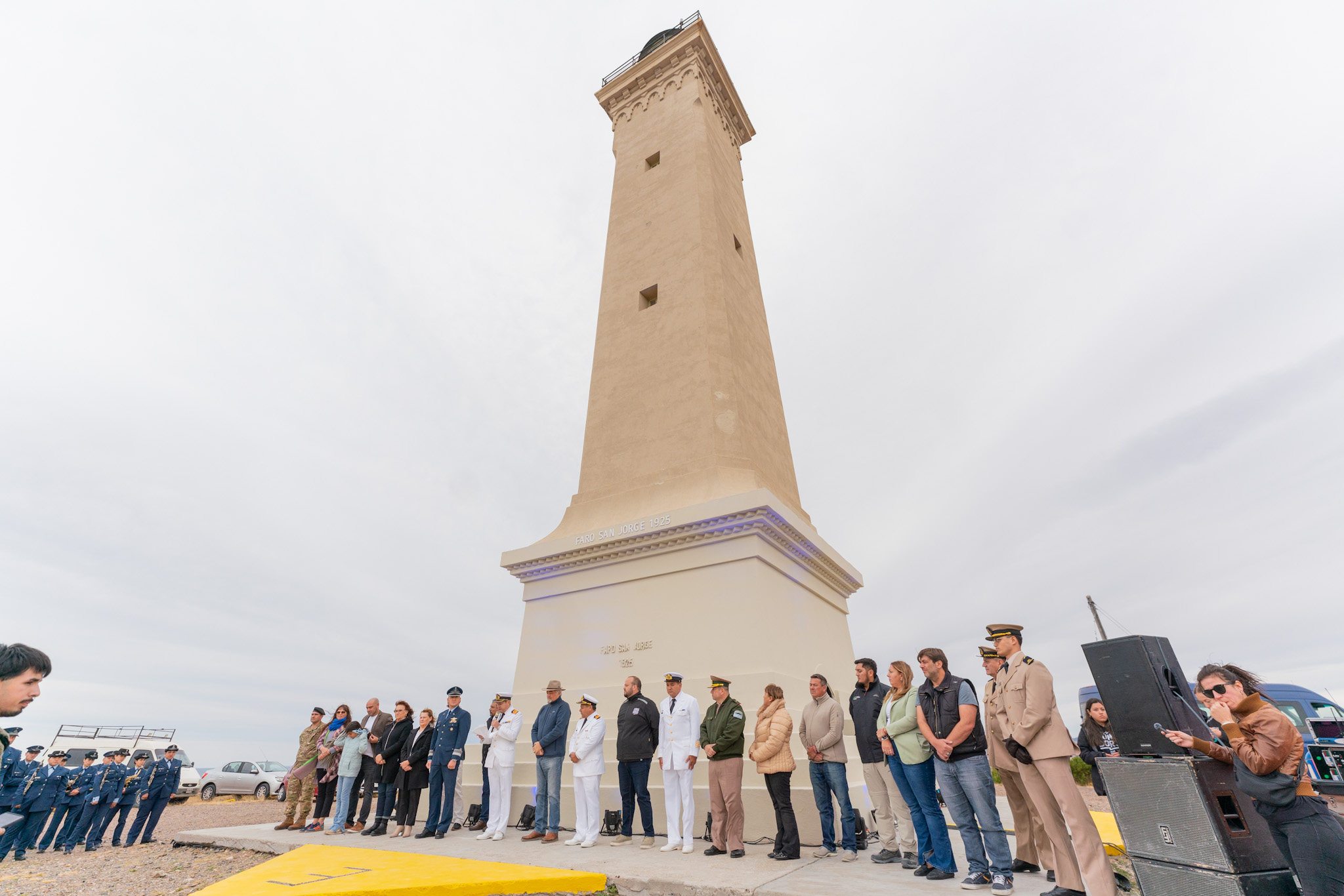
During the last decade, maintenance work on the lighthouse and its surroundings continued, which included the conditioning of the access path and surrounding area. In addition, parking and rest areas were set up, and equipment, historic markers, and identification objects were added to control how the plot was used. As part of the 100th anniversary, the structure was restored and the paintwork and visitor areas were refurbished.
Architectural conservation is complemented by the technical updating of the aid to navigation. In 2024, a 220 V LED light source with an E40 base was installed, and the flashing circuit board and photocell were replaced; a voltage protector was also fitted to the control panel to reduce the vulnerability of electrical and electronic devices to fluctuations in the power supply. The refurbished lighthouse resumed operation, maintaining its navigational function and reinforcing the balance between heritage conservation and operational reliability.
Staff from Comodoro Rivadavia Beaconing Station supervises the lighthouse every fifteen days, checking the condition of the structure, equipment cabinet, internal access, lighting equipment and electrical installations and carrying out cleaning, preservation, and maintenance tasks. This frequency makes it possible to identify any deterioration early enough and take the appropriate action before it endangers assets, safety, or service continuity.
Public Access and Education:
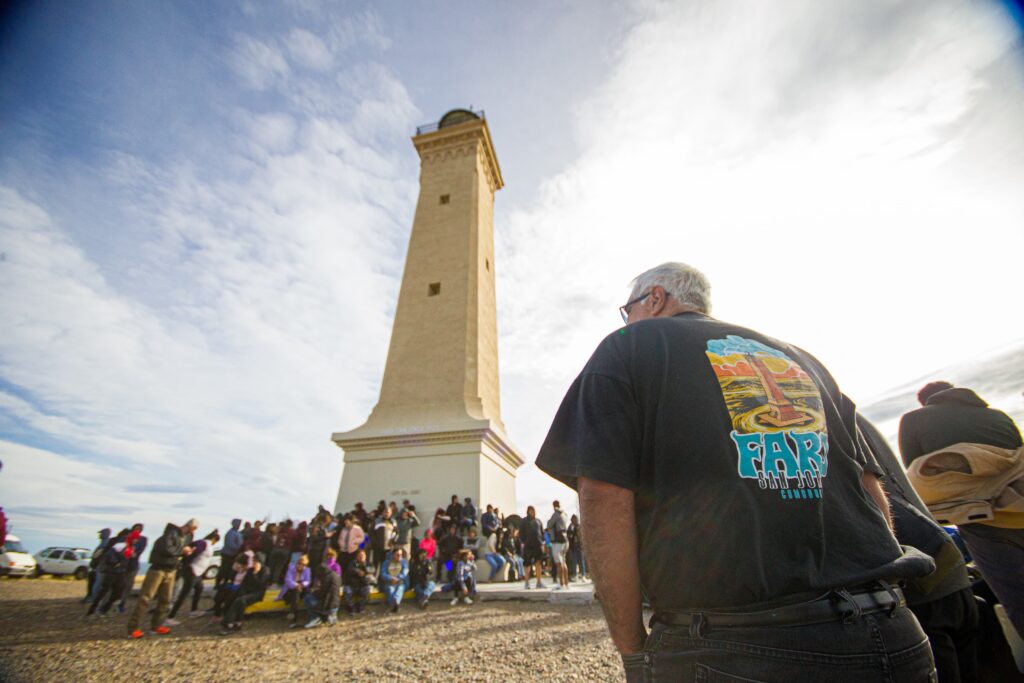
The scheduled access to the inside of the tower is complemented by the frequent use of the surroundings of San Jorge Lighthouse as a promenade area, admiration of the coastal landscape and community gatherings. This combination makes it possible to reconcile the protection and ongoing operation of a navigational aid with its public recognition as part of our maritime heritage.
During guided visits, the tourist guides and the navy staff explain the history of the lighthouse, its architectural characteristics, the evolution of the light system and its current role as an aid to navigation. The tours enable understanding how a maritime signal is identified, its contribution to mariners’ safety of navigation and the tasks performed to keep it operational, including its relationship with the growth of the port, the development of Comodoro Rivadavia and the productive activities that have transformed Patagonia.
The heritage interpretation continues outside the tower through historical and identification signs installed in its vicinity, which provide an opportunity to learn about its history, architectural characteristics and role as an aid to navigation and its relationship with the history of Comodoro Rivadavia.
Workshops and artistic, cultural, and educational activities related to the lighthouse are frequently organized. Educational institutions, children, young people, families and different sectors of the community participate in such activities. Photography, painting, writing, and other forms of expression enable participants to engage with its history, architecture and importance for safety of navigation, spreading the knowledge on maritime signals and strengthening the new generation’s commitment to heritage conservation.
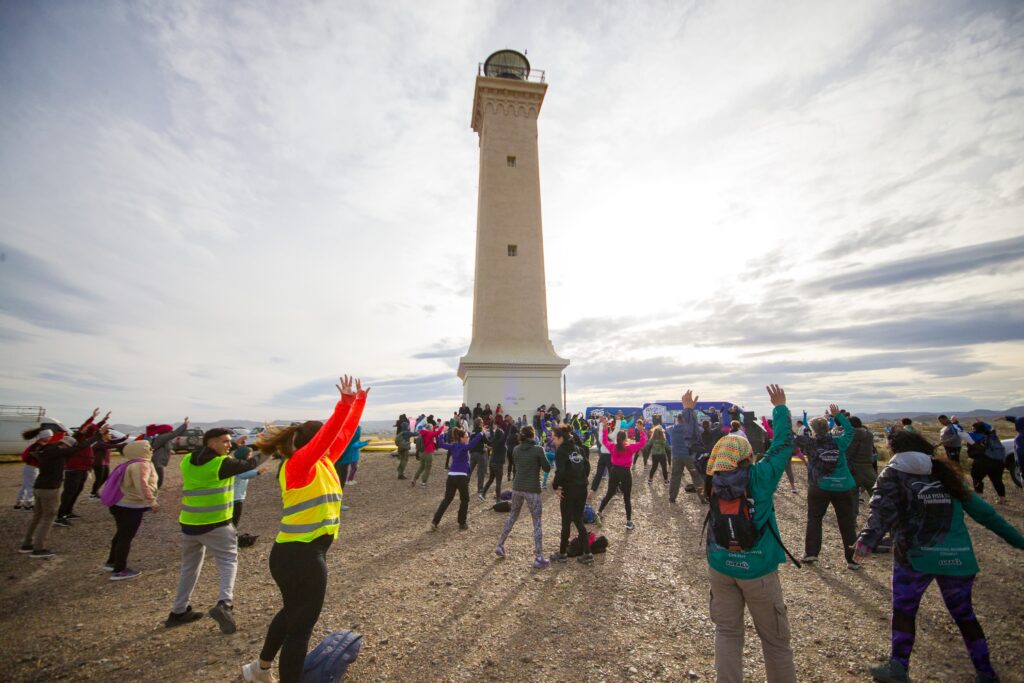
The agenda includes coastal walking tours, sports and recreational activities, environmental proposals and experiences specially aimed at children and young people. Such activities use the lighthouse as a starting point for a joint interpretation of the maritime heritage, the steppe, cliffs, Patagonian winds and the historic relationship between Comodoro Rivadavia and the sea.
The 2025 centenary widened these activities with visits to the inside of the lighthouse, coastal tours, art activities, activities with the community and the dissemination of historical content. Among such initiatives, the photographic contest called “100 years, 100 sights, lights and shadows” promoted new ways of contemplating and interpreting the lighthouse, its light and surrounding landscape. The continuity of such activities envisages that not only do public access and education constitute occasional activities but also well-established components of its heritage value.